 |
| In late Hellenistic Alexandria, the Iliad was divided -probably by Zenodotus-
into 24 rhapsodies (short narrative poems) which, in Greek, are symbolized by the capital letters
of the alphabet. Its central theme is stated in the very first word of the first
verse: (the) menis (anger) of Achilles. |
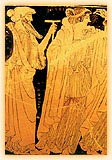
1 (Loimos. Menis. Plague. The anger of Achilles): We are already in the ninth year of the war.
After the invocation of the Muse by the poet, there follows a flashback and we
are informed that Agamemnon, refusing to return Chryseis to her father -a priest
of Apollo- had insulted the god and caused him to vent his fury against the Achaeans.
Agamemnon is forced by the army to return Chryseis, but asks, in return, Briseis
who belongs to Achilles. A quarrel flares between the two leaders, Athena intervenes,
but the infuriated Achilles decides not to participate in the fighting anymore. He asks
his mother, Thetis, to mediate to Zeus in order to be avenged for the
insult he has suffered. Thetis meets with Zeus and the latter consents. |
| 2 (Oneiros. Diapeira. Boeotia or katalogos neon. Dream. Agamemnon puts his soldiers to the test. The catalogue of ships): Zeus sends
a false dream to Agamemnon of a would-be immediate attack and victory. Agamemnon summons
the troops and to test their morale suggests the termination of war and their return to
Greece. As the majority agrees and rejoices Odysseus intervenes and saves the situation, whilst making a fool of the trouble-maker Thersites. There follows
the analytical and accurate catalogue of the Greek contingents and a shorter one of the Trojans and
their allies. |
| 3 (Orkoi. Teichoscopia. Alexandrou kai Menelaou monomachia. Truce. Helen reviews the Achaean champions. The duel of Alexander and Menelaus): The two
armies are ready for battle, but Paris/Alexander is willing to engage in a duel with Menelaus
for the final resolution. Back in Troy, Helen comes to the walls, encouraged by Iris,
where Priam stands and answers the questions of the king identifying the leading heroes of the Achaeans.
In the ensuing duel, Menelaus defeats Paris and would have killed him if it was not for the
intervention of Aphrodite who carries him to the palace wrapped in a cloud. Under the guise of an
old female servant, she tries to send Helen to the arms of Paris, but
Helen discovers the deception and consents only after the threats of the goddess. |
| 4 (Orkion synchysis. Agamemnonos epipolisis. The violation of truce. Agamemnon's review of the champions): In order to keep his promise to Thetis, Zeus
sends Athena to induce Pandaros to break the truce. Pandaros shoots
an arrow, slightly wounding Menelaus. The battle soon begins and Agamemnon,
with admonitions and accusations, tries to spur on the leaders of the Achaeans.
He talks unfairly and reproachfully to Diomedes who, nevertheless,
proves more patient than Achilles. |
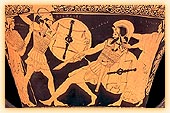 5
(Diomedous aristeia. Diomedes triumphant): The battle of the first day will last up to Book
Seven. Now Diomedes enters the front line and, with the aid of Athena, attacks
the gods themselves. He wounds Aphrodite on her arm, who protects her son Aeneas,
and when she resorts to Olympus, the protection of Aeneas is entrusted
to Apollo. Diomedes attacks him as well but to no avail. The Trojans are
encouraged by Ares. He in his turn is wounded by Diomedes thanks to Athena,
who has taken the place of his charioteer. 5
(Diomedous aristeia. Diomedes triumphant): The battle of the first day will last up to Book
Seven. Now Diomedes enters the front line and, with the aid of Athena, attacks
the gods themselves. He wounds Aphrodite on her arm, who protects her son Aeneas,
and when she resorts to Olympus, the protection of Aeneas is entrusted
to Apollo. Diomedes attacks him as well but to no avail. The Trojans are
encouraged by Ares. He in his turn is wounded by Diomedes thanks to Athena,
who has taken the place of his charioteer. |
| 6 (Ektoros kai Andromachis omilia. The meeting of Hector and Andromache): Diomedes dares the Lycian, Glaucus,
to a duel. However, they realize that they are old friends and finally
exchange armour. Hector and Aeneas return to the city, in order to induce the
women to appease Athena with offerings. Hector meets Andromache on the walls
and there follows a dialogue full of conjugal affection and gloomy premonitions.
Next, he meets Paris and together they join the battle. |
| 7 (Ektoros kai Aiantos monomachia. Nekron anairesis. The duel of Hector and Ajax. The burial of the dead): After being encouraged
by the gods, Hector summons one of the Achaeans to a duel and the lot
falls on Ajax. The duel ends, with the onset of nightfall, with no result.
Greeks and Trojans bury their dead the next morning and, during the day,
the former erect a wooden wall and dig a ditch around the ships. |
| 8 (Kolos machi. Short battle): The following day, Zeus forbids all gods to intervene
in the war and watches the battlefield himself from mount Ida.
For the Greeks, Diomedes excels and for the Trojans, Hector.
The Trojans get the better of the battle and Hera is tempted to disobey the Zeus' order, but
is warded off by Iris. |
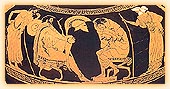 9
(Presveia pros Achillea. Litai. The embassy to Achilles. Prayers): Agamemnon repeats anew the suggestion for the termination
of war. Diomedes opposes it and Nestor advises that they appease Achilles. Agamemnon is willing
to offer many gifts and his proposal is conveyed to Achilles by Odysseus,
Phoenix and Ajax. Despite the friendly reception, Achilles continues to refuse and
replies that he will fight only when the Trojans reach the ships of the Myrmidons.
The embassy returns, disappointed, to the other leaders. 9
(Presveia pros Achillea. Litai. The embassy to Achilles. Prayers): Agamemnon repeats anew the suggestion for the termination
of war. Diomedes opposes it and Nestor advises that they appease Achilles. Agamemnon is willing
to offer many gifts and his proposal is conveyed to Achilles by Odysseus,
Phoenix and Ajax. Despite the friendly reception, Achilles continues to refuse and
replies that he will fight only when the Trojans reach the ships of the Myrmidons.
The embassy returns, disappointed, to the other leaders. |
| 10 (Doloneia. The book of Dolon): It is decided to dispatch Diomedes and Odysseus as spies
to the Trojan camp. However, Hector, in his turn, has dispatched Dolon to spy on
the Achaeans. The two Greeks arrest him and, after they manage to extract
information from him, kill him. In the Trojan camp they kill
the newly-arrived Thracian king, Rhesus, steal his divine horses and
return to the ships. |
| 11 (Agamemnonos aristeia. Agamemnon triumphant): The new day of battle will last up to Book Eighteen.
In the beginning, we have the triumph of Agamemnon which frustrates the designs of Zeus.
The father of the gods, through Iris, urges Hector to keep out of the fighting until Agamemnon, Diomedes
and Odysseus are wounded. Next, Hector returns to battle and forces the Achaeans into
a tight corner. Achilles watches the battle from his ship and sends Patroclus
to bring the news. Patroclus encounters Nestor who instills in him the idea
of persuading Achilles to participate, or at least let himself go into battle bearing the arms
of his friend. |
| 12 (Teichomachia. The assault on the wall): Here begins a part of the fighting which will last up to Book Fifteen.
In these books, events alternate and overlap in a masterly way. The Achaeans
retreat to the ships and the Trojans attack their camp. After the abortive attack
by Asios, the Trojans mount a massive assault, but are warded off by a bad omen
and Polydamas advises them to halt the attack. However, Hector disobeys and smashes through the gate, whilst
Sarpedon pulls down part of the parapet. |
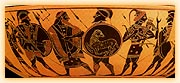
13 (Machi epi tais nausin. Battle for the ships): Despite the ban enforced by Zeus, Poseidon encourages the
Greeks assuming the figure of Calchas and Thoas. Idomeneus fights hard,
but Hector continues his assault. |
| 14 (Dios apati. The seduction of Zeus): Agamemnon talks again about sailing home, but Odysseus
and Diomedes oppose this view. Hera borrows from Aphrodite her magic love
band and seduces Zeus into sexual intercourse following which
the god falls into a deep slumber. The gods who favour the Greeks take the opportunity
to intervene, whilst Hector falls after being hit with a stone thrown by Ajax. |
| 15 (Palioxis para ton neon. Counter-attack by the ships): When Zeus wakes up, the Trojans have been repelled
beyond the ditch. Only then does Hera learn about his will in full detail. Poseidon is
forced to abandon the battle, whilst Apollo puts new heart into Hector, who raids anew
the camp of the Achaeans. The Trojans now threaten the first ships with fire and the only
one who still resists them is Ajax. |
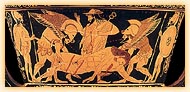 16
(Patrocleia. The book of Patroclus): Patroclus, in tears, begs his friend Achilles, but the latter remains adamant. However, he sends
the Myrmidons to battle and gives his armour to Patroclus, advising him not to
go very far. The Trojans panic at the sight of Patroclus, because they think it is Achilles
himself. They withdraw from the ships and Patroclus chases them and kills Sarpedon,
son of Zeus. Intoxicated by his victory, Patroclus reaches the walls of Troy and faces
Hector in single combat. Apollo, however, disarms him and he eventually gets killed by
Hector and Euphorbus. 16
(Patrocleia. The book of Patroclus): Patroclus, in tears, begs his friend Achilles, but the latter remains adamant. However, he sends
the Myrmidons to battle and gives his armour to Patroclus, advising him not to
go very far. The Trojans panic at the sight of Patroclus, because they think it is Achilles
himself. They withdraw from the ships and Patroclus chases them and kills Sarpedon,
son of Zeus. Intoxicated by his victory, Patroclus reaches the walls of Troy and faces
Hector in single combat. Apollo, however, disarms him and he eventually gets killed by
Hector and Euphorbus. |
| 17 (Menelaou aristeia. Menelaus triumphant): Hard fighting breaks out around the body of Patroclus.
Menelaus kills Euphorbus, whilst Hector strips the armour of Achilles from the dead Patroclus
and dresses himself in it. Athena and Apollo encourage the enemy camps and
the Trojans appear to be the victors. Eventually, Menelaus and Meriones manage
to lift the body under the cover of the two Ajaxes. |
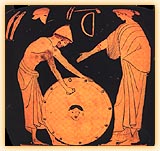 18
(Oplopoiia. The making of new arms): Still the body of Patroclus is in danger and Achilles,
encouraged by Iris, appears on the walls and scares the Trojans with yells.
Hera sends the sun down early and the fighting ends. Hector, disobeying
the advice of Polydamas, keeps the Trojans in the plain, where they set up camp.
Thetis comes to assuage the unspeakable pain of Achilles, and then begs Hephaestus
to manufacture a new armour for her son. The shield, of which we get
a detailed description, is richly decorated with scenes of human activity in peace and
war. 18
(Oplopoiia. The making of new arms): Still the body of Patroclus is in danger and Achilles,
encouraged by Iris, appears on the walls and scares the Trojans with yells.
Hera sends the sun down early and the fighting ends. Hector, disobeying
the advice of Polydamas, keeps the Trojans in the plain, where they set up camp.
Thetis comes to assuage the unspeakable pain of Achilles, and then begs Hephaestus
to manufacture a new armour for her son. The shield, of which we get
a detailed description, is richly decorated with scenes of human activity in peace and
war. |
| 19 (Menidos aporresis. Anger dispelled): The following morning, Thetis brings the new armour
and Achilles calls an assembly of the army to announce his return to the battlefield. Agamemnon
promises lavish gifts as well as the return of Briseis. Achilles hardly permits
the soldiers to eat before battle, and just before they set off, Achilles' horse,
Xanthus, predicts his death. |
| 20 (Theomachia. The gods in battle): Zeus allows the gods to take sides in the battle
and with this the last and toughest battle of the Iliad begins. Achilles
appears particularly ferocious and great opponents such as Aeneas and Hector
only escape thanks to the intervention of Poseidon and Apollo respectively. |
| 21 (Mache parapotamios. Battle by the river): Achilles fills the river Scamander with dead bodies,
the river rises and forces the hero into a tight corner. The gods intervene
and the flood recedes as Hephaestus subdues Scamander. In the battle between the gods,
those who support the Greeks do better. Athena strikes Ares, and Hera, Artemis.
Then they all return to Olympus. Before the walls of Troy, Apollo
(disguised as Agenor) checks the eagerness of Achilles,
until the Trojans hide in the forts. |
| 22 (Ektoros anairesis. The death of Hector): Hector is left outside the walls. His
fate is doomed on the scales of Zeus. In an effort to save himself
from Achilles' zeal, he runs three times around the walls of Troy.
Apollo abandons him and Athena, disguised as Deiphobus, tricks him. Achilles kills him
and then drags him behind his chariot while, on the walls, his parents
and wife break into a terrible lament. |
| 23 (Athla epi Patroclo. Funeral games for Patroclus): The ghost of Patroclus appears to Achilles and asks
to be buried. On the following day the pyre is being readied and among the victims are
twelve young Trojans. The next day the bones of the dead are collected
and games with great prizes take place in his honour. In one of the events
Odysseus and Ajax stand opponents, prefiguring an episode which is not included in
the Iliad. |
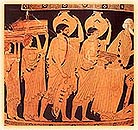 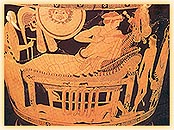 24
(Ektoros Lytra. The ransom of Hector): With an unquenched fury, Achilles continues to drag the dead body
of Hector around the tomb of Patroclus for twelve days. The gods are annoyed
and send Thetis to urge him to release the body to the Trojans. Iris and
Hermes assist Priam, who brings lavish gifts, to cross the lines of the Achaeans
at night. Achilles recalls his own father, his ruthlessness subsides before
the pain of Priam and he surrenders the body which has been preserved intact by the
gods. In the ten-day truce that ensues, the Trojans gather wood and, on the last day,
build a pyre for Hector. 24
(Ektoros Lytra. The ransom of Hector): With an unquenched fury, Achilles continues to drag the dead body
of Hector around the tomb of Patroclus for twelve days. The gods are annoyed
and send Thetis to urge him to release the body to the Trojans. Iris and
Hermes assist Priam, who brings lavish gifts, to cross the lines of the Achaeans
at night. Achilles recalls his own father, his ruthlessness subsides before
the pain of Priam and he surrenders the body which has been preserved intact by the
gods. In the ten-day truce that ensues, the Trojans gather wood and, on the last day,
build a pyre for Hector. |